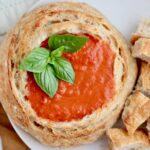
Sourdough Bread Bowls
These Sourdough Bread Bowls are so fun and easy to make at home! Crusty on the outside, chewy on the inside, and sturdy enough to hold your favorite soups, dips, and more.
Servings 2 bowls
Calories 985kcal
Equipment
- Straight-sided container (optional)
- Mini banneton or bowl lined with tea towel
- Bread sling or parchment paper
- Lame or sharp knife
Ingredients
- 1 ¼ cups + 2 tablespoons (330 grams) water
- ½ cup (100 grams) active sourdough starter
- 4 cups (480 grams) bread flour
- 3 ½ teaspoons (10 grams) Diamond Crystal Kosher Salt reduce to 1 ¾ teaspoons if using Morton's brand or table salt
- Rice flour for proofing baskets
- 2-4 ice cubes for steam
Instructions
- Feed your sourdough starter 6–12 hours before you plan to start the dough. It should be bubbly, active, and have doubled in size before mixing. In cooler kitchens (around 65–68°F), this may take closer to 10–12 hours, while warmer kitchens (around 75°F) may only take about 6 hours.
- In a large bowl, whisk together the water and active sourdough starter until the starter is mostly dissolved. Add the bread flour and salt, then mix until no dry flour remains and a shaggy, cohesive dough forms. Cover and let the dough rest for 20 minutes.4 cups (480 grams) bread flour, 1 ¼ cups + 2 tablespoons (330 grams) water, ½ cup (100 grams) active sourdough starter, 3 ½ teaspoons (10 grams) Diamond Crystal Kosher Salt
- Lightly wet your hands to prevent sticking. Grab one side of the dough, gently stretch it upward, and fold it over the center. Rotate the bowl a quarter turn and repeat until you’ve completed 4 folds around the dough. Gather the dough into a loose ball, place it seam-side down, cover, and rest for 15 minutes. Repeat this stretch-and-fold process 3 more times (for a total of 4 rounds), resting 15 minutes between each round.
- Cover the dough and let it rise at room temperature until it has nearly doubled in size, looks puffy, and has bubbles throughout. This can take anywhere from 4–12+ hours depending on your kitchen temperature and starter strength.
- Turn the dough onto a lightly floured surface and gently stretch it into a rectangle. Use a bench scraper or sharp knife to divide the dough into two equal pieces. Working with one piece of dough at a time, fold one short side toward the center, then fold the opposite short side over the top, like folding a letter. Fold the two long sides toward the center in the same way, then flip the dough over so the seam side is underneath. Using your hands or a bench scraper, gently pull the dough toward yourself across the work surface to create tension and shape it into a smooth, tight ball. Repeat with the second piece of dough.
- Lightly dust two mini proofing baskets (or bowls lined with clean tea towels) with rice flour. Place each dough ball seam-side up into a basket. Pinch the seam closed if needed. Cover and refrigerate overnight, or for 12–16 hours.Rice flour
- Place a lidded Dutch oven in the oven and preheat to 450°F. Once the oven reaches temperature, allow the Dutch oven to continue heating for 30 minutes.
- Remove one dough bowl from the refrigerator and turn it out onto parchment paper or a bread sling. Score a square shape on the top of the dough using a lame or sharp knife. Carefully remove the hot Dutch oven from the oven. Add 2 ice cubes to the bottom of the pot to create steam, then carefully lower the dough inside. Cover with the lid and bake for 35 minutes. Remove the lid and continue baking for 5–10 minutes, or until the crust is deeply golden brown. Repeat the baking process with the second bread bowl.2-4 ice cubes
- Transfer the bread bowls to a wire rack and let them cool for at least 1 hour before slicing and filling.
A straight-sided container makes it easy to monitor how much the dough has risen.
Because most Dutch ovens can only fit one bread bowl at a time, bake them separately unless you have two Dutch ovens or a large enough Dutch oven to fit both.
Notes
- Storage: Store in airtight container at room temperature for 2-3 days or freeze for up to 3 months.
Nutrition
Serving: 1bowl | Calories: 985kcal | Carbohydrates: 193g | Protein: 38g | Fat: 4.5g | Saturated Fat: 0.5g | Polyunsaturated Fat: 2g | Monounsaturated Fat: 0.5g | Sodium: 2008mg | Potassium: 336mg | Fiber: 6.5g | Sugar: 0.5g | Calcium: 50mg | Iron: 14.7mg
Did you try this recipe?Let me know! Comment below, or take a picture and tag me on Instagram @everydayhomemadebyashley.
