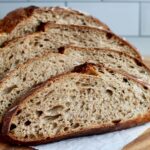
Sourdough Rye Bread
This Sourdough Rye Bread combines rye flour, molasses, and caraway seeds for a hearty, tangy, and flavorful loaf that's easy to make and perfect for beginners.
Servings 12 slices
Calories 160kcal
Equipment
- Banneton or bowl lined with tea towel
- Lame or sharp knife
- Bread sling or parchment paper
- Straight-sided container (optional)
Ingredients
- 2 cups (240 grams) bread flour
- 1 cup (120 grams) whole wheat flour
- 1 cup (120 grams) rye flour light or dark
- 1 ½ cups (360 grams) warm water 80-90℉ (divided)
- 1 tablespoon (20 grams) molasses
- 3 ½ teaspoons (10 grams) Diamond Crystal Kosher Salt measure by weight or reduce volume by about half if using table salt or Morton's brand
- ½ cup (100 grams) active sourdough starter preferably fed with rye flour
- 2-3 teaspoons caraway seeds optional
- Rice flour for dusting bannetone
- 2 ice cubes for steam
Instructions
- About 6-12 hours before baking, feed your sourdough starter with rye flour to ensure it's bubbly and active. The timing will depend on your kitchen temperature - around 75°F takes 6 hours, cooler kitchens (65-68°F) might take 12 hours.
- In a large mixing bowl, combine the bread flour, whole wheat flour, and rye flour with 1 ¼ cups plus 2 tablespoons (330g) of warm water. Mix until combined, cover, and let rest for 30 minutes.2 cups (240 grams) bread flour, 1 cup (120 grams) whole wheat flour, 1 cup (120 grams) rye flour
- In a small bowl, whisk together the remaining 2 tablespoons (30g) of warm water with the molasses and salt to dissolve. Set aside.1 tablespoon (20 grams) molasses, 3 ½ teaspoons (10 grams) Diamond Crystal Kosher Salt
- After the 30-minute autolyse, add your active sourdough starter and the molasses-salt mixture to the flour-water mixture. If using, add the caraway seeds. Mix everything together thoroughly with your hands until a sticky, cohesive dough forms. Cover and let rest for 15 minutes.½ cup (100 grams) active sourdough starter, 2-3 teaspoons caraway seeds
- Wet your hands lightly and perform the first stretch and fold. Grab one edge of the dough, stretch it up, and fold it over itself. Rotate the bowl 90° and repeat this process until you’ve done it on all four sides of the dough. Gather the dough into a ball, flip it folded-side down, cover, and rest for 15 minutes. Repeat this stretch and fold process 3 more times (for a total of 4 sets), resting the dough for about 15 minutes between each round.
- Cover the dough and let it rise until it nearly doubles in size, with visible fermentation bubbles. This can take anywhere from 4-12 hours, depending on your kitchen temperature and starter strength. Rye starters may ferment more quickly, so keep an eye on the dough if you're using one. (Tip: Transfer the dough to a straight-sided container and mark the starting level to track its progress.)
- Once the dough has risen, gently turn it out onto a floured surface. Stretch it into a rectangle. Fold both long sides in toward the center, then fold the short sides in. Flip the dough seam-side down. Use your hands or a bench scraper to shape it into a round ball. Cover and rest for 15 minutes.
- Flip the dough seam-side up again and gently stretch it into a smaller rectangle. If you're using a bowl or banneton, repeat the shaping process above. For a batard, fold the shorter edges of the rectangle toward the center. Then, starting at one of the longer edges, roll the dough tightly into a log, pinching the seam and ends to seal.
- Generously dust your proofing basket with rice flour. Transfer the dough, seam-side up, into the basket. Pinch the seam if needed to seal. Cover and refrigerate for 12-16 hours for cold proofing.Rice flour
- The next day, place a lidded Dutch oven inside the oven and preheat to 450°F. Let the Dutch oven heat for 30-60 minutes once the oven reaches temperature.
- Turn the dough out onto a bread sling or parchment paper. Score the top of the dough with a lame or sharp knife. Carefully place 2 ice cubes in the Dutch oven for steam, then transfer the dough into the hot Dutch oven using the sling or parchment paper. Cover with the lid to trap the steam inside.2 ice cubes
- Bake at 450°F for 45 minutes with the lid on. Then, remove the lid and bake for an additional 5 minutes to achieve your desired crust color.
- Remove the bread from the Dutch oven and let it cool on a wire rack for at least 2-4 hours before slicing and serving.
Notes
- Quick Tip: For best results, use a food scale to measure all of your ingredients by weight.
- Storage: Store bread in an airtight container at room temperature for up to 4 days or slice and freeze for up to 3 months.
Nutrition
Serving: 1slice | Calories: 160kcal | Carbohydrates: 33g | Protein: 6.5g | Fat: 1g | Polyunsaturated Fat: 0.5g | Sodium: 337mg | Potassium: 195mg | Fiber: 5g | Sugar: 2g | Calcium: 20.5mg | Iron: 2.4mg
Did you try this recipe?Let me know! Comment below, or take a picture and tag me on Instagram @everydayhomemadebyashley.
